

Every PPSC and FPSC one-paper test gives you the same deal: 100 MCQs in 90 minutes — 54 seconds per question to read, think, mark and move on. Most aspirants lose this exam on time, not knowledge: they spend three minutes on one stubborn question and then rush the last twenty they actually knew. In MCQ exams, time management is the exam.
This guide gives you a simple, trainable system: the 54-second rule, a section-wise timing budget, the two-pass attempt method that toppers swear by, and three practice drills that make the system automatic before exam day.
The 54-Second Rule: Do the Math Once
Write this number on your study wall: 54 seconds per MCQ. If every question takes you exactly one minute, you will attempt only 90 questions — 10 easy marks left on the table. If every question takes 45 seconds, you finish with time to spare for review. This single number changes how you practice: from today, every mock test you take should feel like a race against 54 seconds, not a relaxed knowledge check.
Here's the practical version of the rule. The moment a question crosses 90 seconds in your head, it is officially expensive — mark it, move on, and come back only if time remains. One hard question carries exactly the same mark as one easy question, but the easy one costs you 20 seconds and the hard one can cost you five minutes plus your nerves.
Section-Wise Timing Budgets
A 90-minute paper is not one paper — it is several small sprints. Before the test, assign each section a time budget based on how fast it can be attempted:
- English grammar & vocabulary (15–20 min): these are the fastest marks in the paper — most are answered in under 30 seconds once your rules are solid. Drill them on our English MCQs under a timer.
- Islamiat & Pakistan Studies (10–15 min): pure memory recall — you either know it in 10 seconds or you don't. Never debate yourself on these.
- General Knowledge & Everyday Science (10–12 min): factual, quick to attempt. Practice in bulk in the Subjects section.
- Current Affairs (8–10 min): recent events are either instantly known or unknown — no calculation needed, so no time wasted.
- Basic Mathematics (12–15 min): the slowest section per question. Do the short ones first and circle back to the long calculations in pass two.
- Computer fundamentals (8–10 min): quick recall for most, but verify each shortcut-style question once.
Notice the pattern: knowledge sections get small budgets because they are binary — you know them or you don't. Skill sections like math get bigger budgets. Write your personal budget on the rough sheet the moment the paper starts, and glance at the clock every 15 minutes.

The Two-Pass Attempt Method
This is the single most valuable technique for any timed MCQ paper, and it is how most toppers actually attempt their tests:
- Pass 1 — the speed sweep (about 40 minutes): attempt only questions you can answer confidently in under 40 seconds. The moment a question feels doubtful, mark it and move on. No pride, no fighting. Most aspirants answer 55–65 questions in this pass.
- Pass 2 — the elimination round (about 30 minutes): return to the marked questions. Use elimination to rule out wrong options, and attempt the ones where you can kill at least two options. Handle the −0.25 negative marking smartly with our negative marking strategy guide — guessing is fine only when it is educated.
- Final review (last 15–20 minutes): check the questions you marked twice, fix any wrongly filled bubbles, and make sure no attempted question is left unmarked. Never change a confident answer in the last five minutes — your first instinct on a timed test is right far more often than your panic is.
Why does this work? Easy marks early build momentum and confidence, while hard questions late can't steal time from questions you would have gotten right. Same 100 questions, same brain — a 10–15 mark difference just from order of attack.
7 Habits That Save You Minutes
- Read the question once, properly. Re-reading stems is the biggest hidden time leak. Read slowly once instead of fast twice.
- Answer the question before looking at options for factual MCQs. If your answer matches an option, you're done in 10 seconds.
- Trust your first instinct on recall questions. Changed answers on knowledge questions flip from right to wrong more often than the reverse.
- Keep your rough work tiny. For math, write only the key numbers — full solutions belong in school exams, not 54-second sprints.
- Fill bubbles in small batches, not at the very end. Marking 20 bubbles every 30 minutes prevents the end-of-paper scramble and the errors it causes.
- Use your wrist, not the wall clock. Set checkpoints: question 33 by minute 30, question 66 by minute 60.
- Never leave easy questions for later. Scan and attempt what you know — the exam pays the same for every correct answer regardless of difficulty.
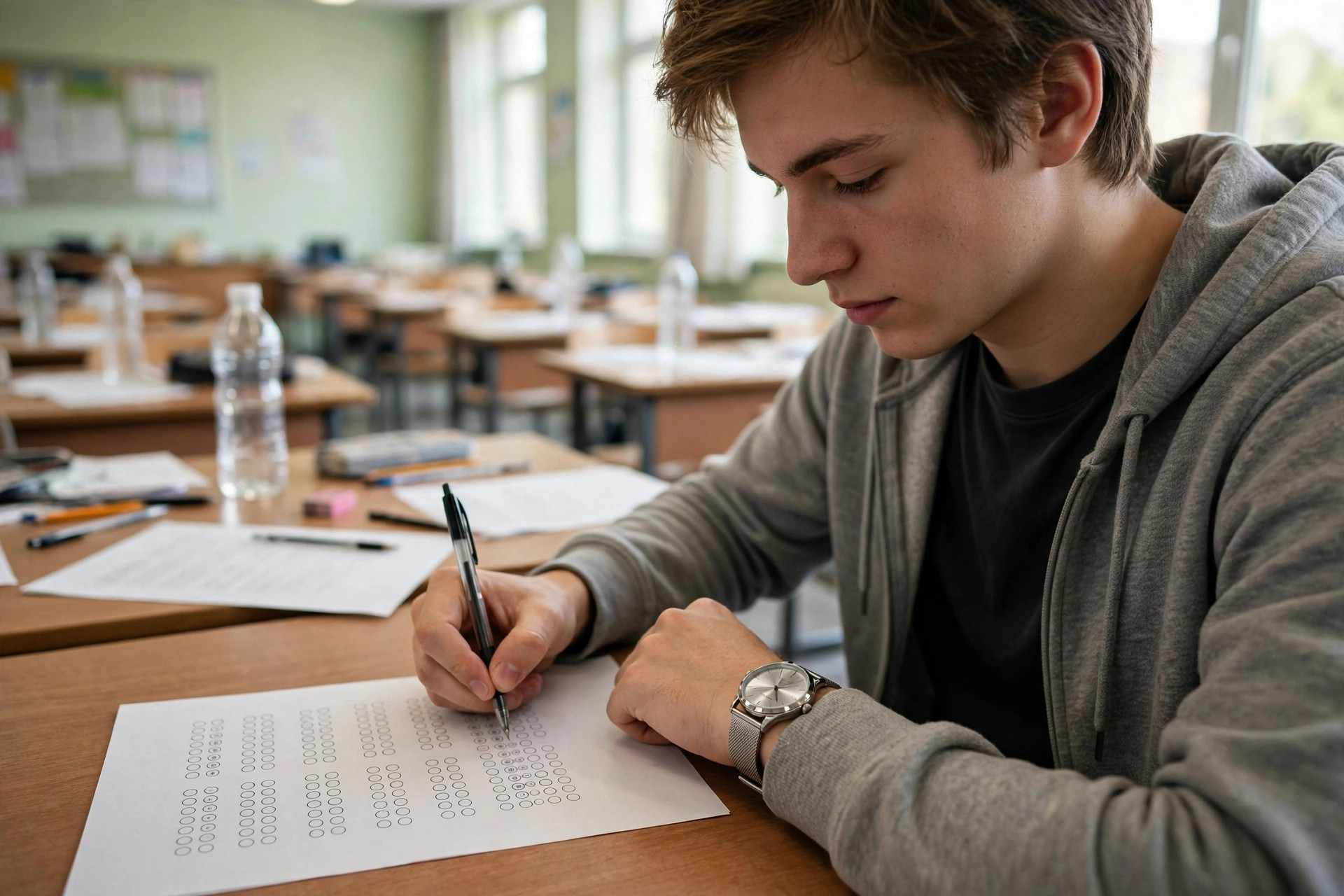
3 Practice Drills That Build Real Exam Speed
Speed is not a talent — it is a trained reflex. These three drills, done twice a week, build the 54-second instinct before exam day:
- The 25-minute sprint: attempt 30 mixed MCQs in 25 minutes with negative marking applied, in our PPSC exam simulator. Track how many you leave — that number should shrink every week.
- The stuck-question drill: during practice, force yourself to skip any question that crosses 90 seconds. This trains the hardest exam skill of all: letting go.
- The review audit: after every timed test, categorize errors — wrong knowledge, rushed reading, or time-starved guesses. If more than 20% are time-related, fix your pace with drills, not more books.
Two weeks of honest timed practice usually buys aspirants 10–15 minutes of effective time — 10–15 more easy questions attempted. That is often the entire difference between merit and rejection.
- 100 MCQs ÷ 90 minutes = 54 seconds per question — internalize this pace in every practice test.
- Budget time by section: fast knowledge sections get less time, math gets more.
- Attempt in two passes — speed sweep first, elimination round second, review last.
- Skip any question that crosses 90 seconds; one hard question equals one easy mark.
- Train speed twice a week with timed drills, not just more reading.
Frequently Asked Questions
How many questions should I attempt in a 90-minute PPSC paper?
Ideally all 100 — but attempt them in the two-pass order. Attempt everything in pass one that you know, then return for educated guesses in pass two. Random guessing costs marks because of the −0.25 negative marking.
What should I do if I run out of time in the last 15 minutes?
Stop solving math-style questions immediately and sweep the remaining paper for easy factual ones — those take 10 seconds each. Fill any still-blank answers only where you can eliminate at least two options.
Is it better to attempt all questions or only the sure ones?
Only the sure ones first, then the educated guesses — that is the whole two-pass system. Leaving a question blank you know nothing about is always better than a blind guess under negative marking.
How do I practice time management at home?
Use a timed exam simulator with negative marking, like our free PPSC mock test, and always practice with a 90-minute timer. Untimed practice builds knowledge; only timed practice builds exam scores.
Practice at real exam pace — free, no login needed
195,477+ MCQs · timed exam simulator · negative marking · full 90-minute mocks